
How To Plant Aloe Vera In Pots (to grow successfully!)
If you’re wondering how to plant aloe vera in pots, you’re in the right place. It’s a plant I love and have grown successfully in containers, both indoors and in the garden. Aloe is well-suited to growing in pots, and I want to share what I’ve learned, including the best potting mix to use, when to plant, the steps to take, and a few helpful tips.
One of the most important things to understand about planting this popular succulent is that it stores water in its fleshy, thick leaves (that soothing gel we all love!) and in its thick, fibrous roots. Because of this, it can rot easily if planted in a soil that stays too wet. A light, fast-draining mix that isn’t heavy is essential for keeping your aloe healthy.
Botanical Name: Aloe barbadensis Common Names: Aloe Vera, Medicinal Aloe, Burn Plant
Planting Aloe Vera In Pots
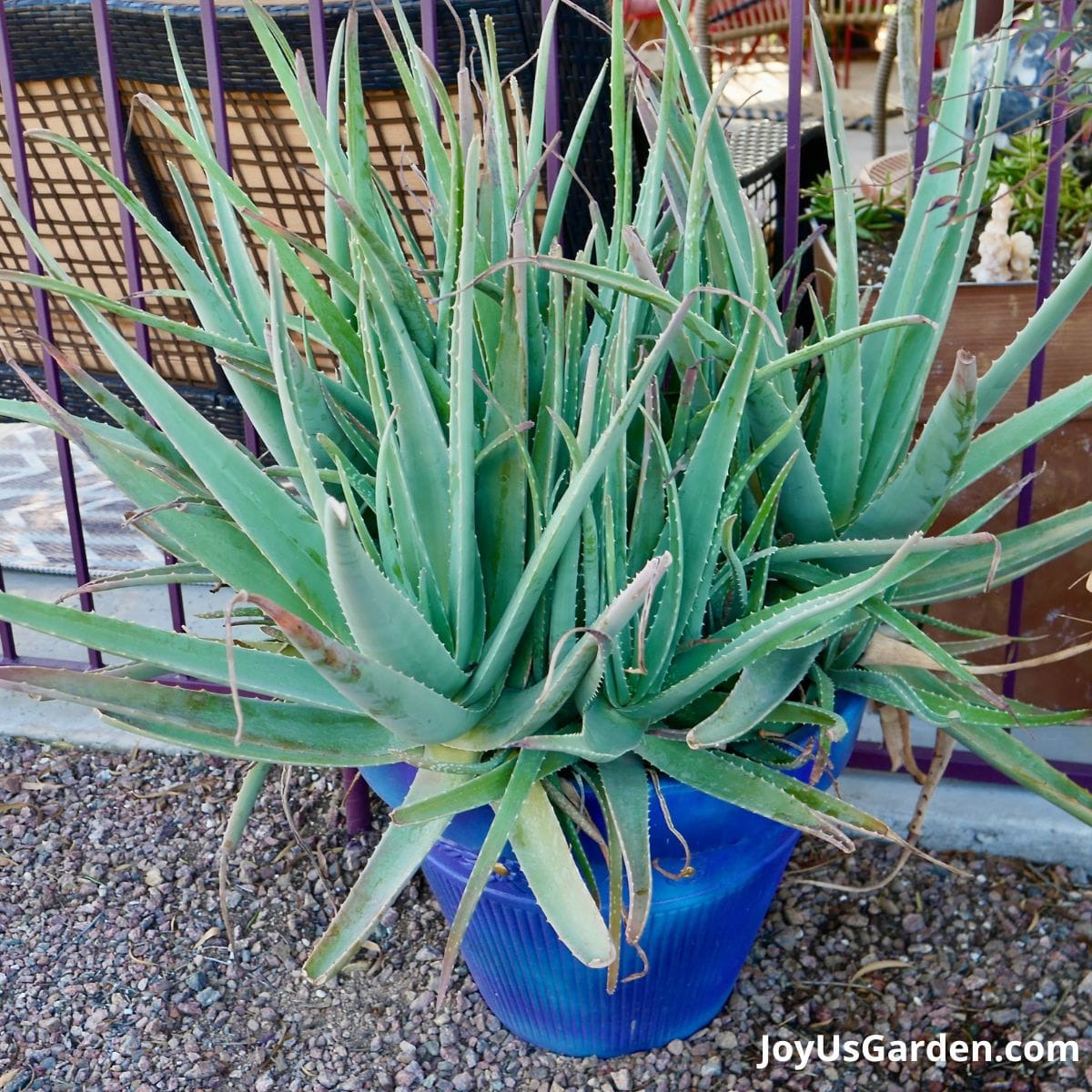
How To Plant Aloe Vera In Pots
Note: The info below applies to planting Aloe vera in pots, whether growing outdoors year-round or as houseplants, except where noted. If you live in a climate with cold winters, having your Aloe in a pot makes it easy to bring it inside during the winter months and back outside in summer.
Best Time to Plant, Transplant, or Repot Aloe
The best time to plant aloe is during the growing season, which is spring and summer. Early fall is fine if you’re in a temperate climate like mine.
Give your aloe at least a month or so to settle in before the nights cool. I live in the Arizona desert, where the nighttime temps don’t drop until mid-December, so I like to have my repotting projects wrapped up by early November.
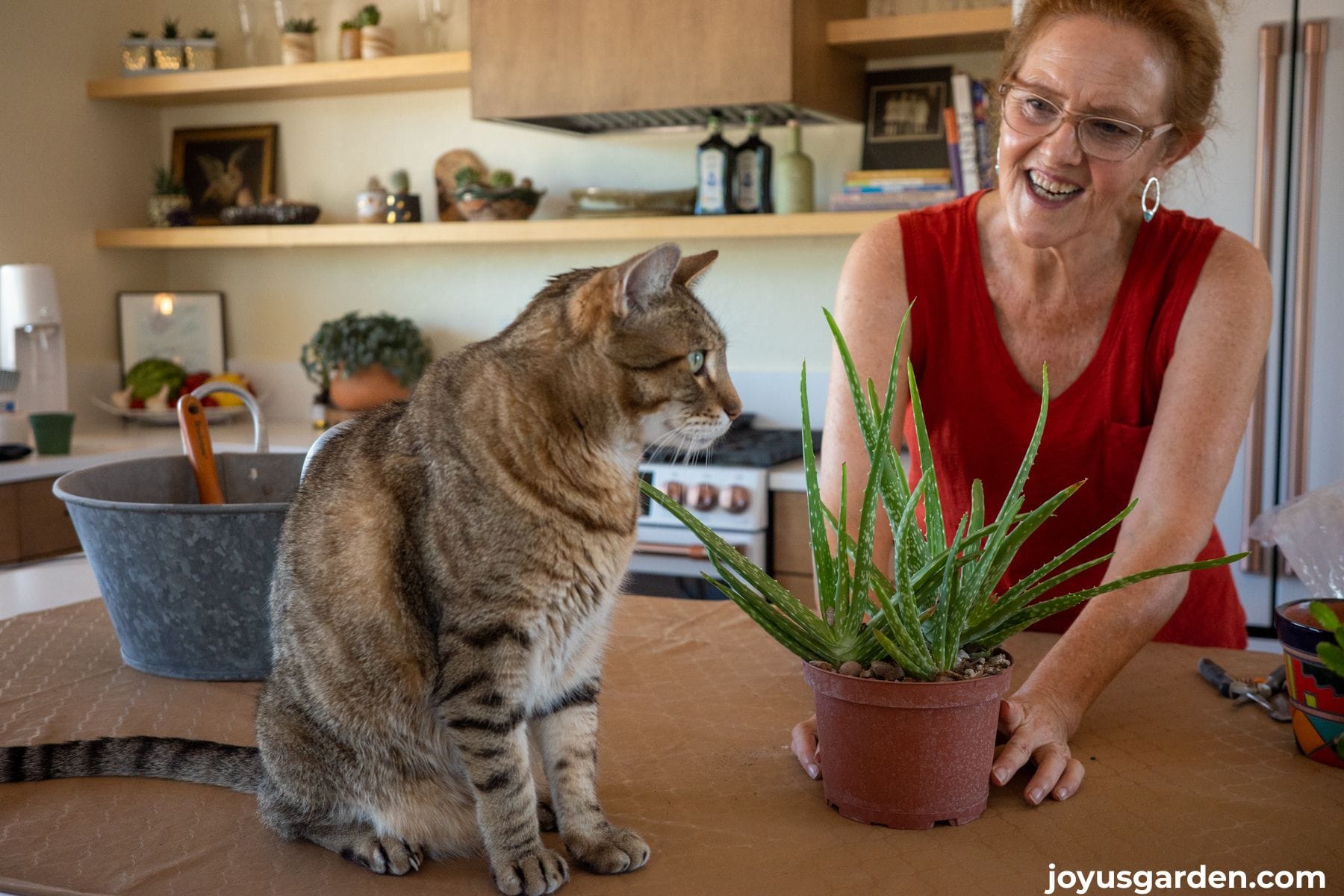
Types Of Pots for Aloe Vera Plants
Aloe vera is a versatile plant when it comes to pot preference. I’ve seen it planted in many different types of pots. Pot type doesn’t matter as much as having well-drained soil.
I love the look of aloe in clay or terra cotta pots, and it does well when directly planted in. Unglazed terra cotta and clay are best because they’re more porous, allowing those big, thick roots to get more airflow.
Ceramic pots are beautiful and come in a wide range of styles, colors, and patterns. I’ve also planted Aloe vera plants in plastic pots, and they’ve done just fine.
Because aloe does best in dry conditions, make sure the bottom of the pot has drainage holes so excess water drains out freely, preventing root rot.
Pot Size for Aloe Vera Plants
In the houseplant trade, Aloe vera is commonly sold in 4″ and 6″ pots. Where grown outdoors, it’s also sold in the landscape trade in 1-gallon and 5-gallon pots.
I generally go up one pot size when planting aloe, but use your judgment here. If your 4″ Aloe plant has gotten way out of scale with its pot and the roots are pot-bound, then moving it into an 8″ pot would be a good idea. If you’ve bought a large 5-gallon Aloe, then a 20″ pot would be fine. When making a big jump in pot size, it’s especially important to get the soil mix right.
Soil Mix For Planting Aloe Vera In Pots
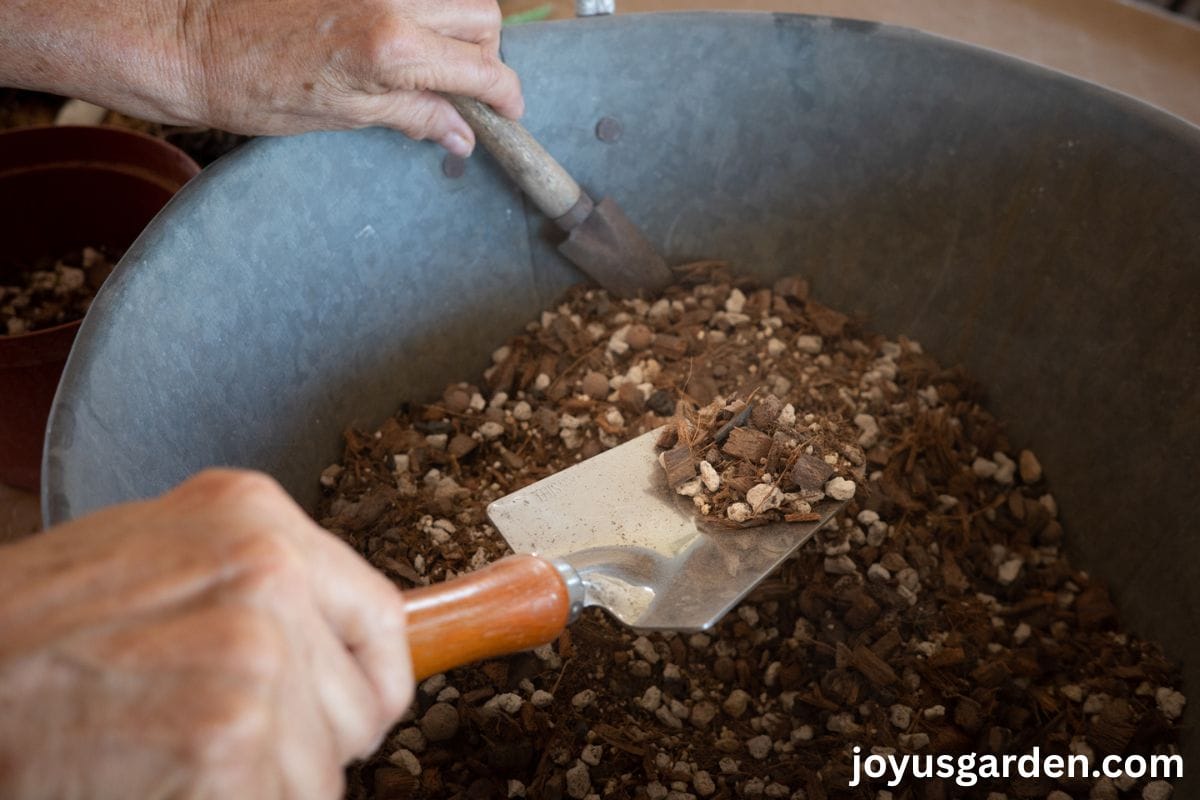
The soil mix needs to provide good drainage and aeration. A lighter mix won’t hold too much water, allowing excess to drain out. This greatly lessens the chance of the soil staying too wet, which eventually leads to root rot.
In the past, I used a commercial succulent mix with a couple of amendments added in. I make my own succulent and cactus potting mix. This succulent and cactus mix recipe isn’t mine – I’m not a soil guru! The folks at Eco Gro shared it with me via its creator, Mark Dimmitt. It’s comprised of coco chips, coconut coir (a more eco-friendly substitute for peat moss), pumice, vermiculite, agricultural lime, and elemite.
I use this DIY mix for all my succulent and cactus container plantings, both indoors and outdoors. You can use straight succulent and cactus potting mix, or make a blend of 1/2 succulent and cactus potting mix and 1/2 potting soil.
For an Aloe vera houseplant, regular potting soil works, but add perlite, pumice, or pebbles for aeration and better drainage. If using a potting soil blend, water less often because it usually holds more moisture.
Succulent potting mix varies by brand – some are heavier than others.
If your mix doesn’t seem light or fast-draining enough, then add pumice, perlite, lava rock, or pebbles.
You don’t need to add compost or worm compost to your potting mix, but it’s how I feed all my container plants, both inside and out. You can read about it here.
Did you know succulents in pots do best in special soil? Here’s the succulent soil mix I use.
Where to Purchase Succulent Mix & Amendments
There are many nurseries and garden centers where I live that sell succulent and cactus mix as well as amendments. In case you don’t have any sources nearby, I’m including these online options.
Mixes
Brands I’ve used include Dr. Earth, EB Stone, Bonsai Jack ( this one is very gritty; great for those prone to overwatering!), and Tanks.
Most of these mixes and amendments can be bought in smaller-sized bags if you’re short on storage space or only have a few succulents. All the succulent mixes I’ve purchased have been good for indoor/outdoor use.
Amendments
To lighten a mix: options include pumice, perlite, clay pebbles, and lava rock.
As nourishment: Worm compost and Compost.
How Often to Repot
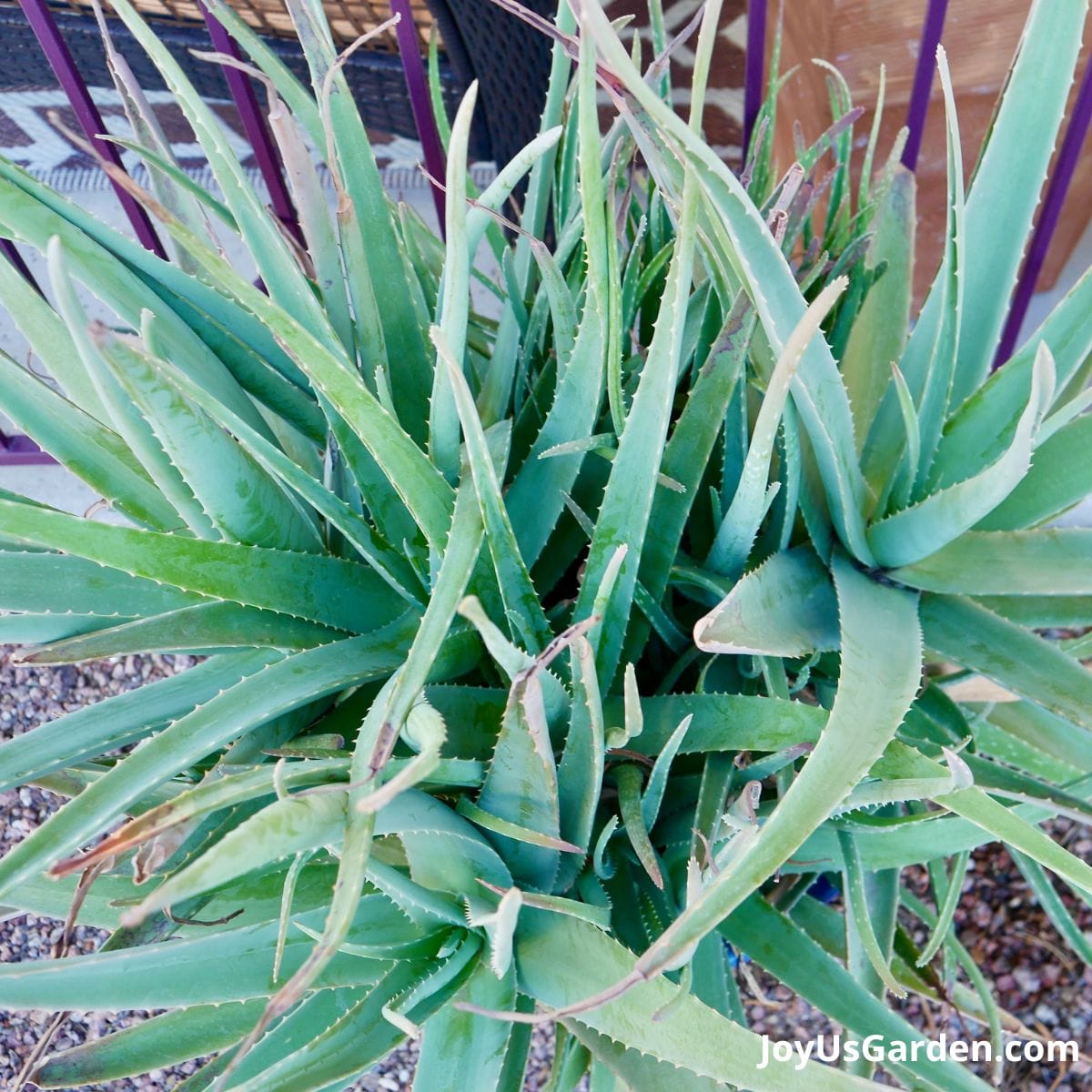
As a general rule, every 4-5 years is fine. Aloe vera becomes very heavy as it grows, so at some point you’ll have to move it into a larger pot to provide a more substantial base.
Aloe vera has strong roots and grows quickly when the conditions are right. That being said, it does best growing a bit snug in its pot, so don’t be in a hurry to move it to a larger pot.
If your plant is small and not growing too much, then leave it in that small pot for a while.
Aloe vera spreads outward as much as it grows upward, and the pot’s diameter will restrict that.
How to Split Aloe Vera
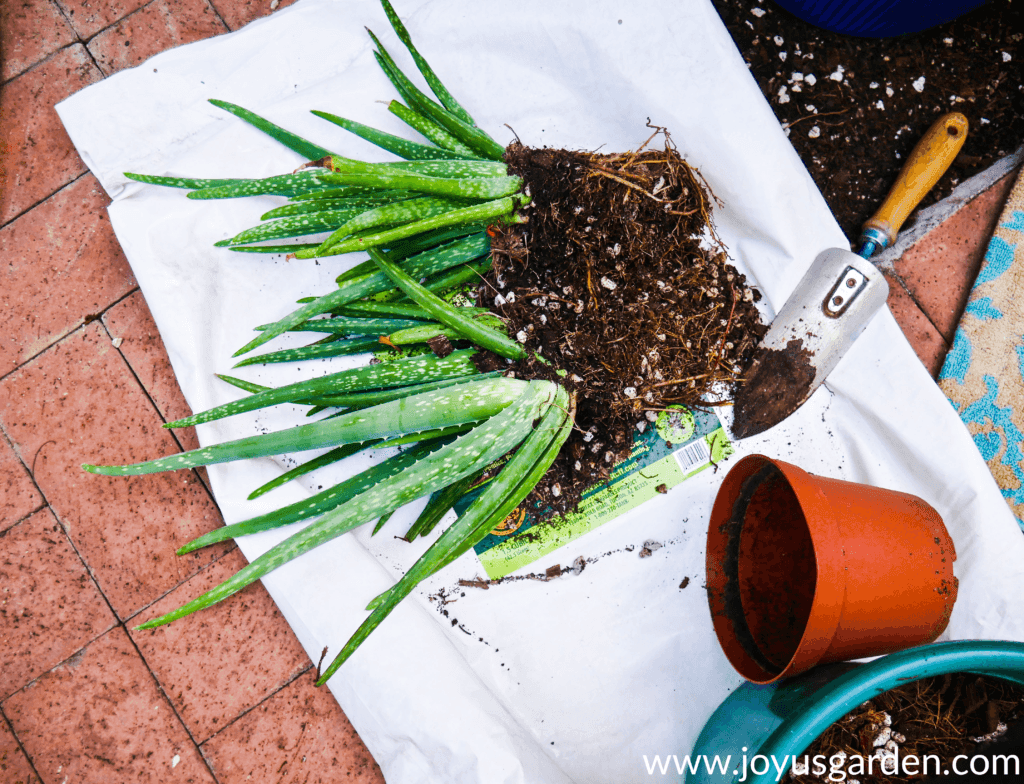
The pups grow attached to the base of the parent plant. If the baby plants are small enough, you can gently separate them by hand.
In the video down below, I used a trowel to divide the pups. A sharp knife would also work. You may lose a leaf or two, and the divisions might not be perfectly even — that’s okay. Aloe vera has thick, sturdy roots and is one tough plant!
For a larger aloe plant with a tight, tough root ball, I’ve used my pruning saw and even a trenching shovel to separate it.
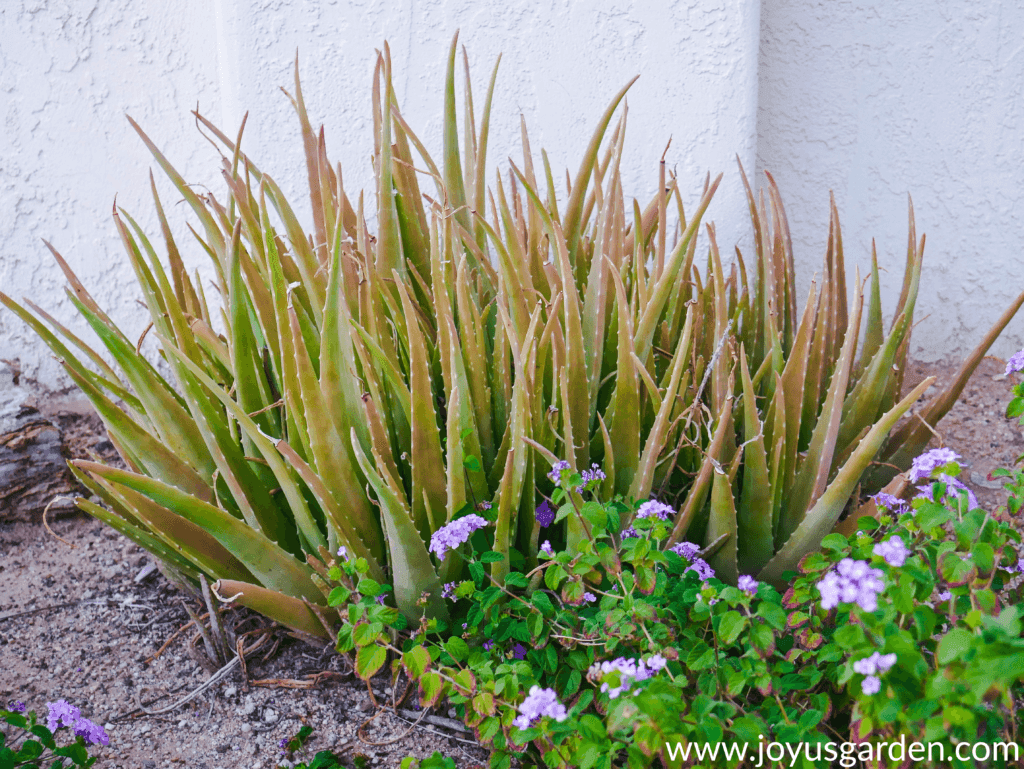
This has nothing to do with planting Aloe vera in pots, but I want to share it because I’ve gotten questions regarding this. You might notice that the mother plant has solid green leaves, while the pups have spots. That’s an age thing – the pups will eventually lose most or all of their spots as time goes on.
Here’s More On Aloe Vera Pups: How To Remove Aloe Vera Pups From the Mother Plant, Aloe Vera Pups: Care and Planting Tips
How to Plant Your Aloe Vera
In a nutshell:
Water your Aloe 5-7 days before planting. You don’t want it to be bone dry, but it shouldn’t be soaking wet either.
Gather all your materials before you begin.
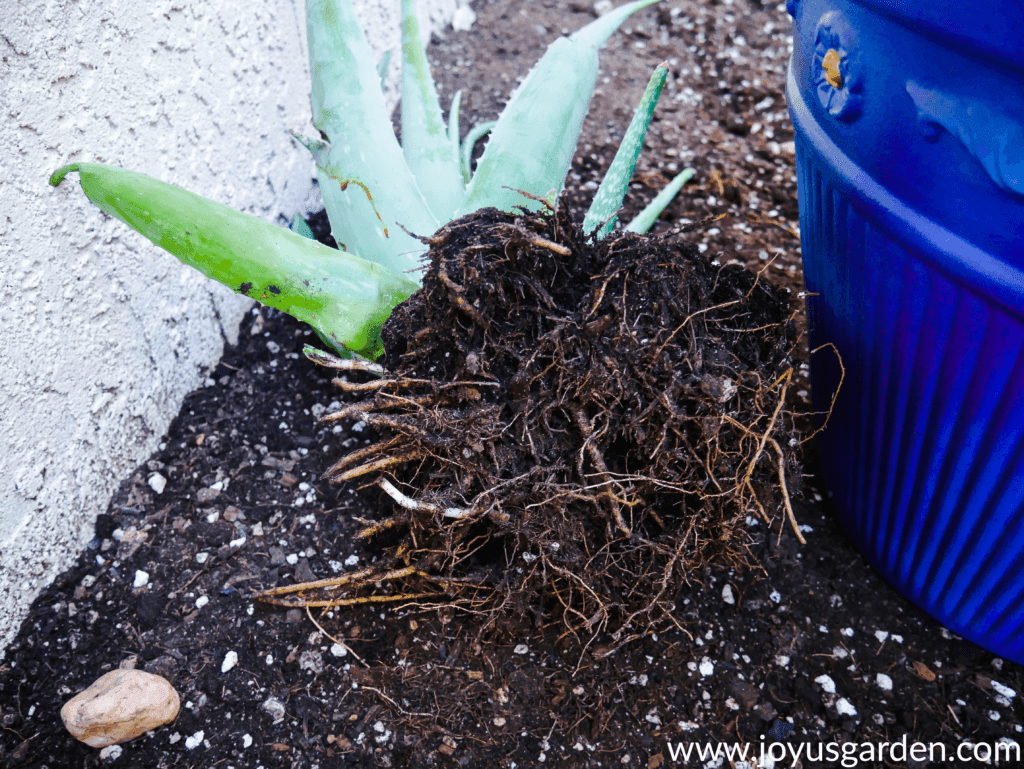
Sometimes you can do this by pressing on the sides of the pot. If that doesn’t work, run a knife around the inside edge to loosen the root ball. If it’s really stuck, you may need to break or cut the pot as a last resort.
Gently massage the roots to loosen them. This helps them spread more easily into the new pot and fresh soil.
Estimate how much mix you’ll need in the pot. I usually measure by eye using my hand or arm. Set the root ball about ½–1 inch above the top of the pot, as the plant’s weight will make it sink over time.
Add the potting mix to the bottom of the pot.
Place the plant in the pot and adjust the soil level if needed.
Fill in around the rootball with the mix. As I plant, I add small amounts of worm compost and compost, and I also use them as a topdressing (optional).
How To Care For Aloe Vera After Planting
Outdoors: I live in the Arizona desert. The plants go in bright, indirect light so they can settle in and the roots can establish without the stress of hot, direct sun. In a coastal climate like Santa Barbara, where I used to live, full sun is fine.
Indoors: Put it in a spot with bright light but no direct sun, avoiding in a west or south-facing window. My Aloe vera sits in a north facing window where it receives light all day, but no burning rays.
It’s best to let succulents settle in before watering. I watered my Aloe plant after a week or so. If it were summer, I would have watered it after 4-5 days.
For a houseplant growing in average temps, I’d wait a week or so. Then, water your Aloe vera and let the mix dry before watering again. A common problem with this plant is watering it too often.
More care guides: Answering Your Questions about Growing Aloe Vera, Growing Aloe Vera Indoors: 5 Common Mistakes to Avoid
Good To Know About Planting Aloe Vera
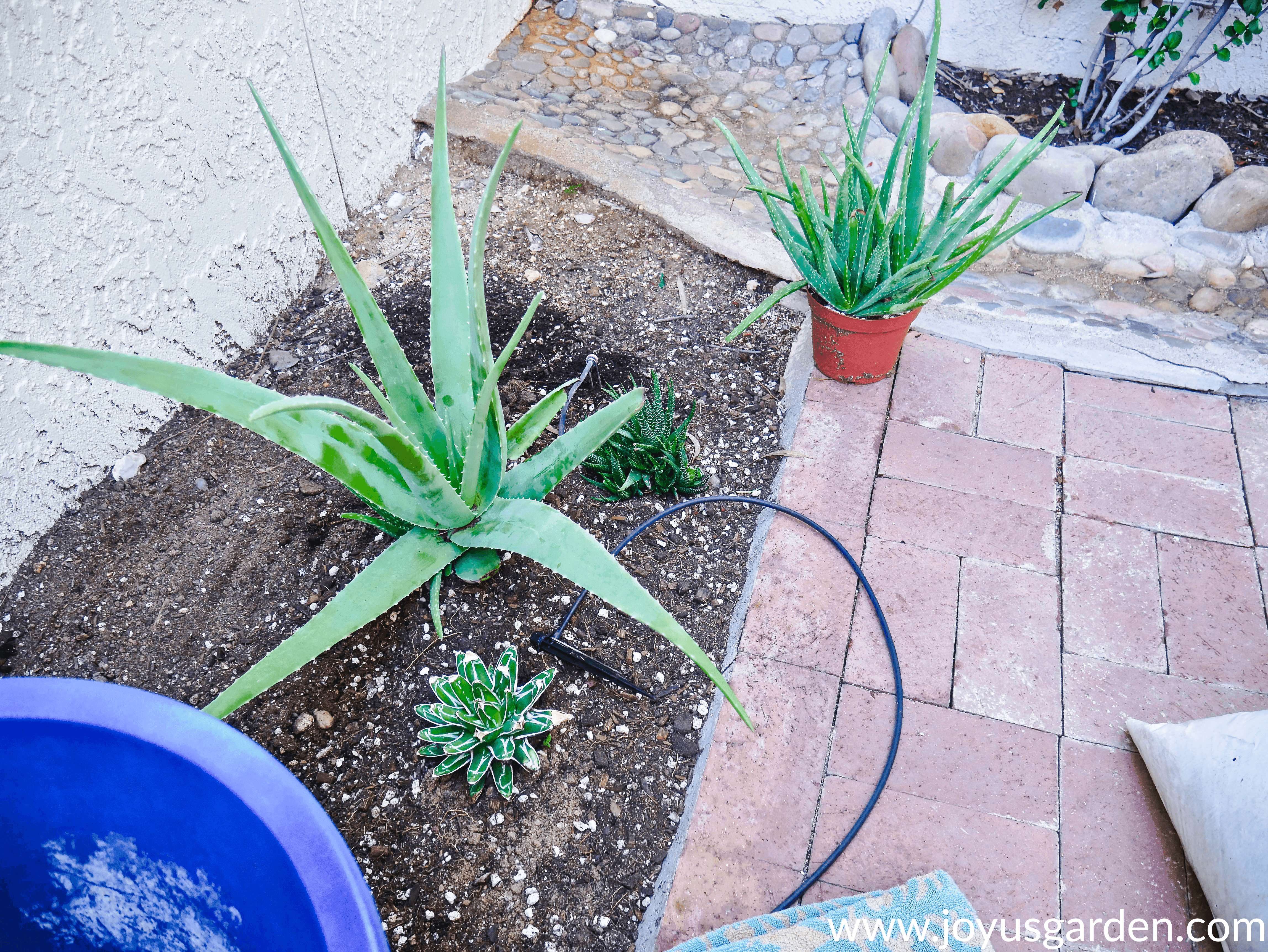
Larger Aloe vera plants can be quite heavy. I had to stake mine for a couple of weeks while it was settling in so it wouldn’t topple over, and you may need to do the same.
Because of the plant’s weight, I usually set it about 1 inch above the soil line when planting. The light potting mix will naturally settle over time, and the plant will sink a bit.
When repotting, go up at least one or two pot sizes, for example, from 4″ to 6″, or from 8″ to 12″. Aloe vera has a strong root system and produces lots of pups when it’s happy, so it needs room to spread in its new pot.
Keep in mind that a larger pot holds more soil. With more soil comes more moisture retention, so be careful not to water too often. Aloe doesn’t like to sit in wet soil.
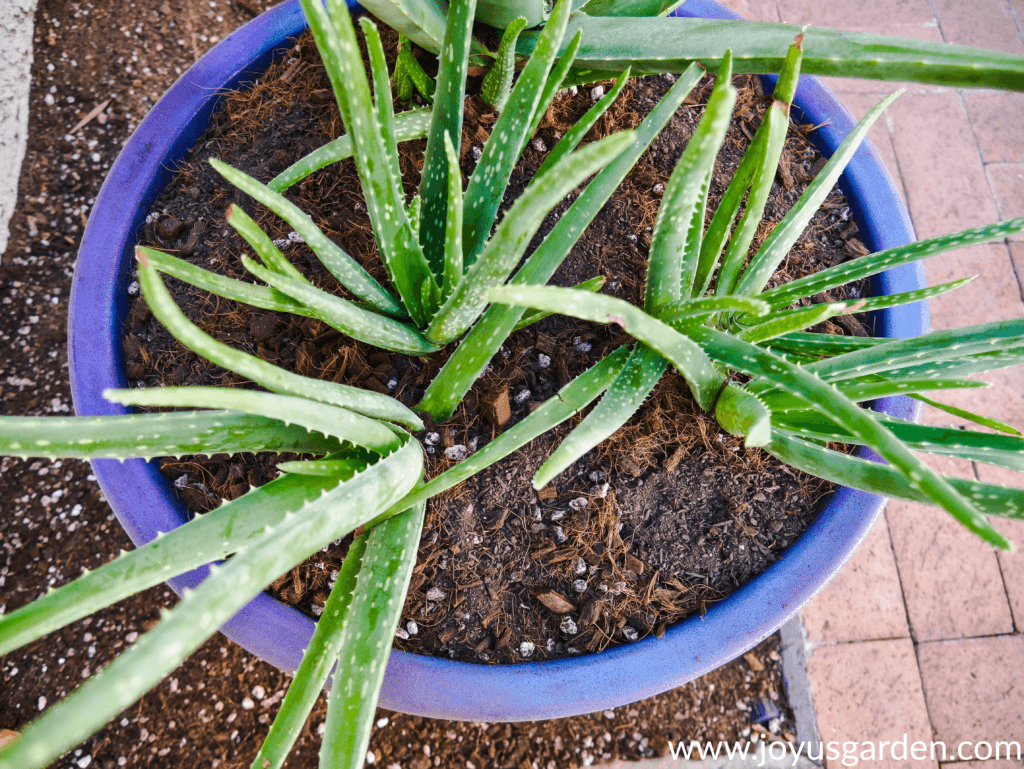
As for materials, mine are growing in plastic pots, but ceramic, terra cotta, clay, and resin all work well too. Terra cotta and clay have a couple of advantages: aloe looks beautiful in them, and if they’re unglazed, their porosity helps the roots breathe.
This succulent doesn’t grow deep roots as much as it grows outward. Mature aloes develop a strong, spreading root system.
As Aloe vera produces pups, they expand outward along with new roots. A wider pot gives them the space they naturally need.
If your Aloe vera is growing indoors, it likely won’t produce babies as quickly or as abundantly as plants growing outdoors.
In my experience, Aloe vera settles in fast. After planting, these felt fairly well rooted within a week when I gently tugged on a leaf. I was able to remove the stake supporting the mother plants after about two weeks.
Video Guide
Conclusion: It’s easy to see why Aloe vera is such a popular houseplant! If you have one Aloe vera plant, you’ll always have plenty to share. This low maintenance plant with healing properties grows beautifully in containers. Follow the tips above, and you’ll have great success planting Aloe vera in pots.
Happy gardening,

- About the Author
- Latest Posts

Nell, the founder of Joy Us garden, was born into a gardening family and grew up in Connecticut’s countryside. After living in Boston, New York, San Francisco, & Santa Barbara, she now calls the Arizona desert home. She studied horticulture & garden design, working in the field all her life. Nell is a gardener, designer, blogger, Youtube creator, & author. She’s been gardening for a very long time & wants to share what she’s learned with you.
Thank you for the specific mixture for aloe vera repotting. I live up in Massachusetts. We have plenty of air moisture for aloes.
Best to you.
You’re very welcome! Nell
Thanks so much I need that information for
You’re very welcome! Nell
hi Nell, I recently came across your videos on aloe Vera plants. I have had my aloe for about 5 months and it produced a couple pups and I recently repotted it.
I have my aloe in my living room where there’s not a lot of sun light (it’s not bright) even with the blinds open and my aloe is close to the window where it can have the light.
should I put it in my bedroom where there’s more sunlight? the aloe will be about 5 feet from the window. if I put it in my room should I open the blinds for a few hours every day.
my bedroom is a east facing window, and my living room is south facing.
Hello,
I do have leave that we cut off, they are ready to plant . What would be the best mixture I will be using miracle grow potting mix, how much sand should I mix in?
I did move a aloe plant from one pot to a bigger pot, I am noticing the leaves are falling. will they bounce back?
Thank you
JOe
I make my own blend Joe. You can use about 1/3 – 1/2 sand to ps. Perlite & pumice work too. Nell
i have an aloe that has grown out of it’s pot…i’ts at least 3 ft long….what do i do with it and why does is grow like that…is the pot too big?
Probably not Jennifer. Aloe vera can grow to almost 3 1/2′ tall. Nell
It’s early November here in New Orleans and daytime temps are between 70*-80* and last night it went dow the lowest so far to 50*. I got busy and I didn’t get to repot my hedgehog aloe (I really wanted to). Do you think I can repot it or stay on the safe side and wait til spring? I might’ve just answered this question but I’d like your opinion. Thanks so much.
Debbie – Just reading this 12/2. I stopped repotting here in Tucson in mid-November because I feel plants need the rest in the cooler months. You’ve probably repotted already! Nell
Hello! I live in Columbia, SC and my aloe is staying indoors due to the colder nights. I bought it in September and repotted it in October while the weather was still warm. Noticed the aloe isn’t growing anymore. I pulled a leaf and it has a dark maroon edge close to the root. I am worried if it’s dying. I haven’t watered it in the past 2 weeks.. pls help.
Hi Usha – When the leaves on an Aloe change color, it’s due to environmental stress. Most plants don’t do a lot of growing after repotting, especially towards winter. Be sure not to over water it. Nell
can you put stem in water to reroot
I live east of Tucson, closer to the New Mexico border. And it does get below freezing in the winter. It’s now May and I just purchased a variety of aloe vera in a 5 gallon pot. I plan to keep it potted. Would placement on the north side of the house be acceptable? And will I need to bring it inside when the temperature drops?
Hi Alicia – Your climate definitely needs a bit of strategy with aloe.
A north-facing spot usually isn’t ideal. Aloe vera prefers lots of bright light and some direct sun, so an east- or south-facing location would be much better. North side may keep it alive, but it can get leggy and grow more slowly.
As for winter, yes, you’ll want to bring it inside (or into a garage/covered area) when temps dip near or below freezing. Aloe isn’t frost-tolerant, and even a light freeze can damage it.